
Data-mining whistleblowers now file nearly half of all False Claims Act qui tam cases. Why the Justice Department changed its mind about them, what the courts now demand, how successful cases actually get through, and whether any of it reduces fraud.
By Jeff Newman Esq. a whistleblower lawyer • September 2026
For most of the False Claims Act’s modern history, the whistleblower was an insider: the billing clerk, the sales representative, the quality-control engineer who saw the fraud firsthand and came forward. That picture is changing fast. A new class of relator has never worked a day for the company it sues. It finds its cases in government spreadsheets.
The Department of Justice now says these “data miners” are driving the largest surge in qui tam filings the statute has ever seen, and it has gone from treating them with suspicion to actively recruiting the best of them. Here is what the record shows, what it does not show, and why it matters.
| The numbers at a glance 980 qui tam complaints in FY2024, then a record. 1,297 in FY2025, a new record, and more than double the level of four years earlier. 780+ in FY2026 through April 30. Annualized, that is roughly 1,340 (author’s computation), which would be a third straight record. More than 45% of all qui tam complaints since FY2024 were filed by data miners, according to DOJ. $6.8 billion in FCA recoveries in FY2025, the largest year in the statute’s history; about $5.3 billion came from qui tam cases. |
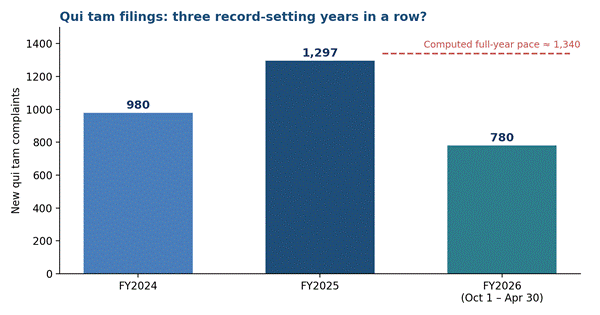
Source: U.S. DOJ (FY2024–25 statistics; FOCUS announcement, Apr. 30, 2026). Pace line is the author’s computation, not a DOJ figure.
1. A new kind of whistleblower “relator”
In a qui tam case, the whistleblower who files the suit is called the relator. A data miner is an individual or company that analyzes publicly available government data, such as Medicare billing files, Paycheck Protection Program loan records, Medicaid spending data, or procurement awards, looking for statistical signals of fraud. When it finds an outlier, it files a sealed qui tam complaint and, if the case succeeds, collects the same 15% to 30% relator’s share an insider would.
In announcing its new FOCUS initiative (Fraud Oversight through Careful Use of Statistics) on April 30, 2026, DOJ’s Civil Division said plainly that much of the recent surge came from people analyzing public government data rather than from the insiders who have traditionally served as relators. DOJ reported that data miners filed more than 45% of qui tam complaints since FY2024. By my rough computation, that is more than 1,375 complaints in about two and a half years.
The pandemic created the conditions. More than 11.5 million PPP loans were issued, and the loan-level data was published. No insider model can police a program of that size one employer at a time. Defense counsel now describe PPP cases brought by data-miner entities as principal drivers of the FY2024 and FY2025 surge. Commentators also report that professional data-miner relators are often backed by litigation funding, and that AI tools are lowering the cost of entry.
The idea is not new. In 1996, a Pennsylvania software company called Health Outcomes Technologies filed a qui tam action that led to settlements with hospitals across the country over a single pneumonia diagnosis code. What is new is the scale, and the government’s open embrace of it.
2. Why DOJ pivoted towards data-mined cases
The shift in DOJ’s posture is striking. In December 2018, DOJ moved to dismiss eleven qui tam cases brought through shell companies organized by a professional-relator group, the National Health Care Analysis Group, and ten of the eleven were ultimately dismissed. DOJ’s filings then reflected open hostility to organizational relators that pursue qui tam suits as a business model. That hostility was driven in part by what DOJ alleged were deceptive methods of gathering information, so the two eras are not perfectly comparable. Still, the contrast with 2026 is sharp. Five developments explain it.
Cause 1: The volume forced a choice
With filings approaching 1,300 a year, and DOJ statutorily obligated to investigate each one, the Civil Division had two options. It could fight the wave by pressing courts for narrower readings of the public disclosure bar and using its dismissal authority more often. Or it could channel the wave. It chose to channel it. FOCUS invites data miners to explain their methods, and DOJ has said it will prioritize those who show pre-filing diligence, analytical rigor, familiarity with program rules, and legally sufficient allegations. Several defense-side commentators read this as triage: a way to separate rigorous data miners from opportunistic ones whose filings drain government resources.
Cause 2: The government itself released the raw material
On February 13, 2026, the DOGE team at HHS published what it called the largest Medicaid dataset in department history: provider-level spending by procedure code and month, covering fee-for-service, managed care, and CHIP claims from 2018 through 2024. One independent analysis counted more than 227 million rows. The release was openly framed as a way to crowdsource the detection of Medicaid fraud, inviting everyone from data scientists to amateur sleuths to look for bad actors. Having invited the public to mine the data, the government needed a way to receive and sort what came back. Whistleblower counsel report that data miners responded quickly, aware that the FCA rewards only the first to file.
Cause 3: A White House anti-fraud mandate
On March 16, 2026, the President issued an Executive Order establishing a Task Force to Eliminate Fraud, chaired by the Vice President. It directed DOJ to promote meritorious qui tam cases and to review them promptly, including within the FCA’s 60-day seal period where practicable. DOJ followed with a new National Fraud Enforcement Division in April and, on May 27, a Civil Division memorandum requiring initial review of benefits-fraud qui tams within 60 days and no later than 120. Assistant Attorney General Brett Shumate framed the reforms as a way to act quickly on meritorious cases and make the most of finite enforcement resources. FOCUS sits inside this broader, administration-wide build-out of data analytics.
Cause 4: The results were real
Data-mined cases have produced recoveries DOJ can point to. PPP cases have yielded settlements from the hundreds of thousands of dollars into the millions, including one relator’s suits against country clubs and homeowners associations; four California organizations alone paid about $5.8 million. In the Medicare context, a data-analytics firm’s case against a California vascular practice settled in 2026 for more than $6.7 million. Data mining also reaches fraud that insiders cannot: small borrowers and solo practices rarely have a whistleblower on staff.
Cause 5: Technology changed who can play
DOJ’s own announcement acknowledged that the spread of advanced agentic and AI capabilities allows new players into the space, and it welcomed both established and new data miners who show rigor. At a January 2026 conference, a Civil Division deputy assistant attorney general put it memorably: a company’s next whistleblower could be its data.
| Which cause mattered most? That cannot be established from the public record. DOJ has not said which factor drove its decision, and the timing (Medicaid data release in February, Executive Order in March, FOCUS in April, accelerated-review memo in May) is consistent with all five working together. My own reading, offered as inference rather than finding, is that volume and the anti-fraud mandate made engagement necessary, and the government’s own data releases made it unavoidable. |
| Date | Development |
| 1996–2004 | Health Outcomes Technologies, a software company, files a qui tam that leads to DOJ-intervened pneumonia-upcoding settlements with hospitals nationwide. |
| Dec. 2018 | DOJ moves to dismiss 11 professional-relator cases (NHCA); 10 of 11 dismissed. |
| 2020–2021 | Fifth and Ninth Circuits reject Integra Med Analytics’ statistics-only complaints. |
| June 2021 | DOJ intervenes in Integra’s New York nursing-home case (Integra v. Laufer), its first intervention in an Integra case. |
| FY2024 | Record 980 qui tam complaints filed. |
| FY2025 | Record 1,297 qui tam complaints; $6.8 billion in FCA recoveries. |
| Feb. 13, 2026 | HHS/DOGE publishes provider-level Medicaid spending data (2018–2024). |
| Mar. 16, 2026 | Executive Order creates the Task Force to Eliminate Fraud. |
| Apr. 2026 | DOJ creates the National Fraud Enforcement Division. |
| Apr. 30, 2026 | DOJ launches FOCUS; reports data miners filed 45%+ of complaints since FY2024. |
| May 27, 2026 | Civil Division memo: 60–120 day initial review for benefits-fraud qui tams. |
| July 17, 2026 | FOCUS page updated with a seven-topic white-paper questionnaire. |
3. Who is doing it
- Integra Med Analytics. An early data-forensics relator that applies statistical models to public Medicare claims. It lost at two circuits: U.S. ex rel. Integra Med Analytics v. Baylor Scott & White Health, 816 F. App’x 892 (5th Cir. 2020), cert. denied, and Integra Med Analytics v. Providence Health & Services, No. 19-56367 (9th Cir. Mar. 31, 2021). But it has also won. A Texas court largely denied a motion to dismiss in 2019, DOJ intervened in its New York nursing-home case in 2021, and three Illinois facilities settled with it in 2026. Those cases are discussed in Section 7.
- Lincoln Analytics, Inc. A data-analytics firm filing on Medicare billing outliers. In U.S. & California ex rel. Lincoln Analytics v. Serrano, No. 23-cv-04178 (C.D. Cal.), a vascular practice and its physician agreed to pay more than $6.73 million; Lincoln’s share was about $976,000. An earlier Lincoln case, No. 2:22-cv-06501 (C.D. Cal.), was unsealed after DOJ declined to intervene.
- Relator LLC. A PPP serial filer formed by two California attorneys. U.S. ex rel. Relator LLC v. Manela, No. 2:22-cv-04781 (C.D. Cal.), settled for about $802,000, with Relator LLC receiving about $80,000. Its case against a mortgage lender produced a significant 2026 Ninth Circuit opinion, discussed below.
- Wade Riner. An individual serial relator whose PPP suits targeted private country clubs and homeowners associations that were ineligible for loans because of their tax status. His cases have produced both settlements and dismissals.
- GNGH2, Inc. A for-profit relator that brought PPP-based claims against 15 entities alleged to operate nursing homes in the Bronx.
- The professional-relator precedent. The National Health Care Analysis Group’s shell LLCs brought eleven nearly identical cases against 38 defendants before DOJ moved to dismiss them. Its methods relied partly on interviews rather than pure data analysis, but it remains the cautionary example courts and DOJ cite.
What is not known: DOJ has not published intervention rates, dismissal rates, or recovery totals for data-miner cases specifically, so no one can say what share of the $6.8 billion came from data miners. DOJ has, however, said something qualitative: in announcing FOCUS, it stated that recent settlement and judgment data suggest a lower overall success rate for data-miner complaints than for complaints the Department initiates itself.
4. What the courts are saying
Statistics alone will not survive a motion to dismiss
The Integra decisions set the baseline. The Fifth Circuit held that Integra’s statistics were consistent both with fraud and with Baylor simply being ahead of other hospitals in following new CMS coding guidelines, a lawful and obvious alternative explanation. Even with statistics, the court said, a relator must plead particular details of the fraudulent scheme. The Ninth Circuit agreed in Providence.
The Seventh Circuit reinforced the point on August 17, 2026, in U.S. & Illinois ex rel. Enloe v. Heritage Operations Group, No. 24-1431. The majority said it was not holding that an outsider can never bring a qui tam, but an outsider cannot assume unlawful practices without a particularized factual basis. A concurring judge thought the complaint adequately pleaded the who, what, when, where, and how, yet still agreed dismissal was right because materiality was not pleaded.
The public disclosure bar is less of a wall than defendants hoped
In U.S. ex rel. Relator, LLC v. Erskine, No. 25-2073 (9th Cir. July 15, 2026), a published opinion, the district court had dismissed a PPP case because the lender’s industry code was visible on PandemicOversight.gov. The Ninth Circuit reversed. The code showed the company was a lender, but SBA rules allowed some lenders to qualify, so the public data did not disclose the fraud; the relator’s added analysis of which exception applied did the work. The court also held that a company’s own website is generally not “news media” under the bar.
The same opinion shows the limit. The relator’s claim that the lender inflated its headcount rested on the square footage of one of eleven offices. The court called that speculation.
DOJ keeps the power to end weak cases
Courts have consistently upheld DOJ’s authority to dismiss qui tam cases it considers not worth pursuing, including the professional-relator cases in United States v. UCB, Inc., 970 F.3d 875 (7th Cir. 2020), and U.S. ex rel. Health Choice Alliance v. Eli Lilly, No. 19-40906 (5th Cir. 2021). The Supreme Court confirmed the breadth of that authority in Polansky (2023). The May 2026 memo makes dismissal for lack of specificity one of three options at the end of the fast-track review.
The qui tam device itself survives, for now
On September 1, 2026, the Eleventh Circuit in Zafirov, No. 24-13581, reversed the 2024 district court ruling that qui tam relators are unconstitutionally appointed officers, joining the Fifth, Sixth, Ninth, and Tenth Circuits. It remanded the defendants’ remaining arguments under the Take Care and Vesting Clauses, and commentators expect a petition to the Supreme Court.
| The judicial line, in one sentence An outlier alone loses; an outlier plus program-rule analysis, an explanation of why innocent causes do not fit, and some real-world corroboration can survive. |
5. Will it reduce fraud?
The case for yes. A peer-reviewed study by Boston University economist Jetson Leder-Luis in the Review of Economics and Statistics (2025) estimated that deterrence from $1.9 billion in whistleblower settlements generated nearly $19 billion in Medicare savings, roughly ten dollars saved for every dollar recovered, at low cost to the government. And data mining reaches programs, like PPP, where insider tips could never scale.
The necessary caveat. That study examined successful whistleblower cases in Medicare from 1999 to 2016, most of them brought by insiders. Applying its ten-to-one result to data-miner cases is extrapolation, not evidence. No published study yet isolates the deterrent effect of data-mined qui tams.
The case for caution. Every filing, meritorious or not, consumes DOJ investigative time. Relators paid as a share of damages have some incentive to let damages accumulate before filing, although first-to-file rules push the other way. And outliers often have innocent explanations, which is exactly why courts dismiss statistics-only complaints.
Where the evidence stands. There is a sound basis to say qui tam enforcement deters fraud. There is not yet a basis to say data-miner cases specifically do. The likely answer is that rigorous data mining deters and careless data mining mostly generates cost, which is the distinction FOCUS is built to draw.
6. Where data mining works best
Defense counsel list pandemic relief, Medicare and Medicaid billing, Medicare Advantage risk adjustment, procurement, customs and tariff data, and some federally guaranteed mortgage filings as the main areas so far, with immigration, DEI, and cybersecurity expected next. The table below adds my own assessment of why each works or does not.
| Segment | Public data | Why it works, or where it struggles (author’s assessment) |
| PPP / EIDL | SBA loan data; PandemicOversight.gov | Bright-line eligibility rules that data can test. Struggles when relators guess at facts such as headcount. |
| Medicare billing | CMS provider utilization files | Peer benchmarks expose extreme outliers. Struggles where clinical judgment supplies an innocent explanation. |
| Medicaid | HHS provider spending data (released Feb. 2026) | New, massive, provider-level. Too new for case results. |
| Medicare Advantage | Limited public data | Coding intensity is visible, but “ahead of the industry” is the defense that defeated Integra. |
| Kickbacks | CMS Open Payments | Links payments to prescribing. Correlation is not intent. |
| Procurement and grants | USAspending; FPDS | Pricing and labor-category anomalies against peers. |
| Customs and tariffs | Mostly commercial shipping data | Origin and classification mismatches. No data-mined customs recovery turned up in my research. |
The common thread, in my assessment: the strongest segments combine entity-level public data, a written eligibility or payment rule the data can test, a peer group to benchmark against, and a solvent defendant. The weakest are those where professional judgment offers a lawful reason for the outlier.
7. How data-mined cases got through, and how some didn’t
Published opinions are almost all about cases that failed, because a settlement rarely produces an opinion. So I looked at the other side of the ledger: data-mined cases that settled or survived, and what, if anything, tested them along the way. The surprising answer is that most of the successful cases never faced a decided motion to dismiss at all.
The pioneer: Health Outcomes Technologies (1996–2004)
HOT filed in 1996 in the Eastern District of Pennsylvania (No. 96-1552). DOJ described it as a software company that sold products to health care providers, not an insider at any hospital it named. Settlements followed with hospital after hospital over one diagnosis code, 482.89, pneumonia due to “other specified bacteria”; they included Newton-Wellesley (1999), Leesburg Regional ($1.48 million, 2003), Palm Springs General ($2.09 million, 2003), and three Tenet hospitals in Florida, and HOT received relator shares in the settlements DOJ announced. I found no reported ruling on a motion to dismiss in any of them. The statistics were apparently never tested in court because the government converted them into chart-level proof: settlement agreements recite that hospitals produced the patient files behind the targeted claims, and one hospital’s self-audit found claims the medical records did not support. The outlier started the inquiry; the medical records finished it. (Public sources do not describe HOT’s method in detail. That it relied on claims analysis is my inference from the pattern of the cases.)
The one that beat the motion: Integra v. Creative Solutions (W.D. Tex. 2019)
Integra alleged more than $94 million in false Medicare claims by a Texas nursing-home network, using both quantitative and qualitative analysis. The defendant pointed to Integra’s losses against Baylor and Providence. The court distinguished them: here Integra did not rely on statistics alone but supported them with interviews of former employees, who supplied specifics such as a therapist’s account of being told to fabricate and back-date evaluations. The motion was granted only as to the reverse-false-claims and conspiracy counts. I could not find how the case ended.
The first intervention: Integra v. Laufer (S.D.N.Y.)
Integra filed on December 1, 2017, against eleven New York skilled nursing facilities, their operator, and his management company. DOJ intervened in June 2021 and filed its own complaint, alleging after its own investigation that the scheme continued through 2019 and that the owner and a senior employee instructed and pressured staff. On September 23, 2022, the court denied the motion to dismiss except as to two common-law claims against two defendants. Note what was tested: DOJ’s complaint, built on DOJ’s investigation, not Integra’s statistics alone. I found no reported resolution.
Quick settlements: Symphony, Serrano, and Manela
Three Illinois nursing facilities settled Integra’s case for $300,000 in 2026, based on ability to pay, with $45,000 to Integra. Lincoln Analytics filed against Dr. Serrano’s vascular practice on May 30, 2023, and the practice settled for more than $6.73 million. Relator LLC filed against Yosef Manela and his companies on July 13, 2022, alleging duplicate PPP applications, false payroll figures, over-cap compensation, and false certifications of need; the case settled for about $802,000. I found no decided motion to dismiss in any of the three.
The bright-line cases: Wade Riner’s PPP suits
Riner’s theory needed no statistics: certain nonprofits were simply ineligible for PPP loans. That produced settlements, including four California clubs and associations that paid about $5.8 million, and a Michigan country club that paid more than $440,000. It also produced failures. In Colorado, Riner voluntarily dismissed his suit against 25 associations and clubs after they moved to dismiss, arguing he had no inside knowledge and relied only on public facts; some defendants also produced documents showing they were in fact eligible. In Florida, a federal judge dismissed five defendants; the report I found does not say on what grounds.
The ones that did not get through
In August 2024, a federal court in the Eastern District of California dismissed a Relator LLC case against a mortgage lender under the public disclosure bar. In February 2026, a Central District of California judge dismissed Relator LLC’s suit against the Bighorn country club with prejudice, finding that every essential fact had already been publicly disclosed.
| What the record suggests (author’s inference) Something more than the outlier. Statistics paired with witnesses or with medical-record review survived; statistics alone did not. A bright-line rule the data proves directly. An ineligible organization cannot explain away its tax status. DOJ’s own investigation. Most settlements followed government intervention, so the relator’s pleading was never tested at all. Defendants who fought on public-disclosure grounds won more often than they lost. |
8. The stage of a False Claims Act case the courts rarely see
Most commentary on data-mined cases focuses on the motion to dismiss, because that is where the published opinions are: in the litigation phase, not the early phase of the case. The record in Section 7 points somewhere else. In the cases that succeeded, the decisive work happened earlier, while the complaint was still under seal.
How the sealed period works
A qui tam complaint is filed under seal and served on the government together with a written disclosure of the relator’s material evidence. The claim belongs to the United States; the relator sues in its name. The seal runs 60 days by statute and is routinely extended while DOJ investigates.
During that period DOJ is not limited to the relator’s spreadsheet. Since 2009, the statute has allowed the Attorney General or a designee to issue civil investigative demands, for documents, written answers, and sworn testimony, before deciding whether to intervene. The same amendment lets DOJ share what it obtains with the relator when it decides that is necessary to the investigation. Agency inspectors general have subpoena power of their own.
Why that matters for Rule 9(b)’s “particularity” requirement
A statistical outlier is a question. The defendant’s records are the answer. Under seal, the government can ask the question with compulsory process, pulling the charts, loan files, or billing records the data points to, long before any defendant files a motion. The HOT settlements show it: the hospitals’ own patient files, not the statistics, established what was billed and why. Laufer shows it too: DOJ’s complaint extended the alleged conduct through 2019 and named who gave the instructions, and that complaint largely survived the motion to dismiss.
Rule 9(b) of the Federal Rules of Civil Procedure sets a higher bar for fraud than for most claims. Ordinarily a complaint needs only a short and plain statement of the claim. A party alleging fraud, however, must “state with particularity the circumstances constituting fraud,” although knowledge and intent may be alleged generally. Because a False Claims Act complaint alleges fraud on the government, courts apply the rule to qui tam cases and usually describe it as requiring the who, what, when, where, and how of the scheme. The circuits differ on how much more is needed. Some require the relator to identify representative false claims that were actually submitted. Others, including the Fifth Circuit in U.S. ex rel. Grubbs v. Kanneganti, 565 F.3d 180 (5th Cir. 2009), accept particular details of a scheme paired with reliable indicia that lead to a strong inference that claims were submitted. For a data miner, this is the hard part: a regression can show that billing is unusual, but it rarely shows who did what, when, and why.
When DOJ intervenes, it files its own complaint built from what it has gathered. The defendant’s particularity argument is then aimed not at a relator’s regression but at a complaint drawn from the defendant’s own documents. My reading, offered as inference: in the settled cases, the 9(b) question was effectively answered in the sealed investigation, which is why so few of them produced a ruling at all.
DOJ’s newly stated preference toward data-based cases
Current policy pushes in this direction. Under FOCUS, DOJ asks data miners to address alternative explanations and to explain how their data, combined with other evidence, suggests both falsity and scienter, and it says it will prioritize those who show pre-filing diligence. The May 2026 memo compresses initial review of benefits-fraud qui tams into 60 to 120 days. My inference: faster review makes the quality of the initial filing matter more, because a complaint that tells DOJ exactly which records to demand, and what those records should show if the fraud is real, is one it can verify inside that window.
The limits
A relator cannot issue a civil investigative demand. If DOJ declines, the relator faces the motion to dismiss with only what it had at filing, and the dismissals described in Section 7 show how often that pleading cannot stand on the data alone. DOJ also keeps the power to dismiss cases it does not want.
Where this leaves whistleblower counsel
DOJ has told data miners to partner with people who understand program eligibility rules and regulatory frameworks. That work increasingly lands on firms like ours. In my view, the job is to turn a statistical signal into a disclosure the government can act on: which program rule the data tests, which innocent explanations fail and why, which records would confirm or refute the pattern, and where to find them. Done well, that work shortens the government’s investigation and answers the particularity question before a defendant ever raises it.
| The process point, in one sentence In a data case, the seal period is where an outlier becomes evidence, and the government holds the tools that make the conversion. |
9. What to watch
- FY2026 statistics, likely released in January 2027, to see whether the pace near 1,340 held.
- Whether DOJ publishes intervention and recovery data for data-miner cases. That is the number that will settle the debate.
- Enloe, Erskine on remand, and the first Medicaid-data cases to reach a motion to dismiss.
- How Integra v. Laufer and Integra v. Creative Solutions finally resolve.
- A Supreme Court petition in Zafirov on the remaining constitutional questions.
- Whether the FOCUS questionnaire becomes the de facto pleading standard, with defendants citing it to argue that a complaint lacks the rigor DOJ itself requires.
Jeff Newman Law is a national whistleblower law firm handling False Claims Act, tariff fraud, and SEC whistleblower cases. You can reach the firm at www.JeffNewmanLaw.com or 617‑823‑3217.
Principal sources
- U.S. DOJ, Civil Division Announces FOCUS Initiative for Data Miners Filing Qui Tam Complaints (Apr. 30, 2026; updated July 17, 2026), and FOCUS White Paper Questionnaire.
- U.S. DOJ, Civil Division Moves to Fast-Track Benefits Fraud Enforcement (May 27, 2026).
- U.S. DOJ, FY2025 False Claims Act statistics (Jan. 2026), as summarized by Wiley, Dorsey, Ropes & Gray, and Holland & Knight.
- U.S. ex rel. Relator, LLC v. Erskine, No. 25-2073 (9th Cir. July 15, 2026).
- U.S. & Illinois ex rel. Enloe v. Heritage Operations Group, No. 24-1431 (7th Cir. Aug. 17, 2026).
- U.S. ex rel. Zafirov v. Florida Medical Associates, No. 24-13581 (11th Cir. Sept. 1, 2026).
- U.S. ex rel. Integra Med Analytics v. Baylor Scott & White Health, 816 F. App’x 892 (5th Cir. 2020); Integra Med Analytics v. Providence Health & Servs., No. 19-56367 (9th Cir. 2021).
- United States v. UCB, Inc., 970 F.3d 875 (7th Cir. 2020); U.S. ex rel. Health Choice Alliance v. Eli Lilly, No. 19-40906 (5th Cir. 2021).
- U.S. DOJ press releases: Serrano Kidney & Vascular Access Center settlement (May 2026); Manela PPP settlement (Sept. 2024).
- Jetson Leder-Luis, “Can Whistleblowers Root Out Public Expenditure Fraud? Evidence from Medicare,” Review of Economics and Statistics 107(5): 1169–1186 (2025).
- Analyses of the Feb. 2026 HHS Medicaid data release (McDermott+, Epstein Becker Green) and of FOCUS (Dorsey, WilmerHale, Akin, Crowell, Dentons, Arnold & Porter, Reed Smith, Lieff Cabraser).
- U.S. ex rel. Health Outcomes Technologies, E.D. Pa. No. 96-1552: DOJ settlement agreements and press releases (1999–2004), including Newton-Wellesley, Leesburg Regional, Palm Springs General, and Tenet Florida hospitals.
- U.S. ex rel. Integra Med Analytics v. Creative Solutions in Healthcare, No. SA-17-CV-1249-XR (W.D. Tex. Nov. 13, 2019) (order on motion to dismiss).
- U.S. ex rel. Integra Med Analytics v. Laufer, No. 7:17-cv-09424 (S.D.N.Y.): complaint-in-intervention (June 2, 2021); bench ruling on motions to dismiss (Sept. 23, 2022).
- U.S. DOJ, Three Affiliated Skilled Nursing Facilities to Pay $300,000 (May 2026), U.S. ex rel. Integra Med Analytics v. Symphony Healthcare, No. 20-cv-0348 (N.D. Ill.).
- U.S. ex rel. Relator LLC v. Kootstra, No. 1:22-cv-00924 (E.D. Cal. Aug. 5, 2024); Bighorn country club dismissal (C.D. Cal. Feb. 9, 2026), as reported by defense counsel.
- Wade Riner PPP matters: U.S. ex rel. Riner v. Bay Harbor Yacht Club, No. 1:24-cv-284 (W.D. Mich.) (DOJ release, Aug. 2024); California settlements (June 2024); Colorado and Florida proceedings as reported.
- 31 U.S.C. § 3733 (civil investigative demands), as amended by the Fraud Enforcement and Recovery Act of 2009.
- Fed. R. Civ. P. 9(b).
- U.S. ex rel. Grubbs v. Kanneganti, 565 F.3d 180 (5th Cir. 2009).